


Why is it a system?
Because alignment on expectations cannot run on positive or negative feedback alone.
I know that there are cultures that avoid negative feedback at all costs, and it often creates a very strong reaction in the people receiving it. So when someone has to be fired and they weren’t getting any corrective feedback - how is it being explained? A lay-off every single time? Or “we just need to let you go”? Or how do people learn to do better? Isn’t telling someone what needs to change actually a form of care?
I know there are people who take feedback very personally - negative feedback is being perceived as a doubt of their overall capacity to do the job, an unfortunate consequence of associating one’s self-worth with the job they are doing. But unfortunately giving positive feedback only with hope that a person understands it as “do more of that” and “do other things not listed differently” - is not exactly a clear type of communication. It’s more of a mind-reading exercise.
Providing only negative feedback, on the other hand, with time would create a problem even for those employees that don’t need validation. There’s a bias our minds have: when we consistently receive only one type of signal, our minds begin to interpret it as the complete picture. So if a person during their job experience only receives negative feedback they would start thinking that they are not being appreciated in an environment, or they are just being tolerated, or feel unsupported, or even feel targeted. There should be a reason why they are not receiving positive feedback at all, right? And sometimes there’s a reason. Sometimes the reason is that someone doesn’t want to acknowledge the contribution as a part of toxic power play. Sometimes people are just forgetful and are not paying attention to the fact that their feedback has no balance. Regardless, it damages morale, trust, and increases turnover.
The balance
Ideally, employees should receive more positive feedback than negative feedback to maintain transparency, effectiveness, and productive relationship with the company and their manager.
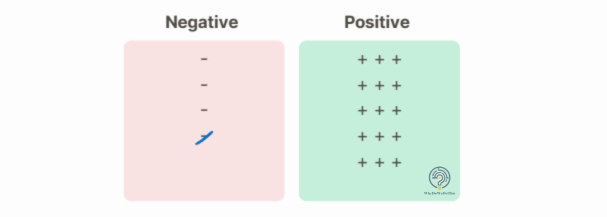
It is crucial for managers to keep track of the quantity and type of feedback they are giving to maintain an engaged environment and avoid the negative impact of an unbalanced approach.
A lack of balance is a problem I have seen the most during my career. Managers are usually too busy with their own and their teams’ KPIs, politics, delivery, etc., to keep an eye on the feedback balance. This is why it is so vital to bring attention to it first.
Feedback Checklist
Fact-check. Make sure you have enough concrete examples, not hearsay or interpretation.
Timing. Give feedback close to the event. If it’s corrective feedback it’s best to avoid giving feedback in the heat of the moment.
Privacy. Choose the right setting: criticism should be given exclusively in private, recognition can be given publicly or privately.
Clarity over comfort. Don’t dilute the feedback just to avoid discomfort.
Separate, don’t sandwich. Keep positive and developmental feedback separate.
Mind the dynamics. Be aware of your own mindset and relational roles.
Aim for growth. Feedback is not punishment - it’s an investment in someone’s development.
Self-check before giving feedback:
Am I fact-based and specific?
Is this the right time and place?
Do I separate behavior from identity?
Have I been giving regular positive feedback too?
Am I calm, confident, and in “coach” mode?
Underwater currents:
Confidence
Low confidence on the manager’s end can produce avoidance, sugar-coating, or apologizing too much.
High confidence (if unchecked) can lead to harsh delivery, lack of empathy and awareness.
Friendship vs. Friendly
Friendship can blur professional clarity. Risks: avoiding feedback to “keep the peace” or delivering harsher criticism because emotions are involved, taking advantage of the relationship by both sides.
A friendly attitude, on the other hand, remains respectful and warm while maintaining professional boundaries. It allows honest yet kind feedback.
Karpman drama triangle
Roles:
Persecutor (“You’re always wrong, I’ll punish you”)
Victim (“I’m powerless, you’re unfair”)
Rescuer (“I’ll save you, don’t worry about your responsibility”)
The goal is to stay outside the triangle in a Coach/Observer role: “I see this behavior; here’s how it impacts; how can we solve it together?”
Corrective (negative) feedback
There are several frameworks I use that are perfectly stackable and have served me best: SBI, Non-violent communication, Radical candor.
SBI (Situation, Behavior, Impact)
The principle is literally: Situation → Behavior → Impact
It works because it’s factual, specific, and focuses on action or behavior with clarity about why they have a negative impact on the other people or organization.
Example:

Non-violent communication
This method came to work environments from psychotherapy practice and, similarly to SBI, also avoids commenting on the character or personality using the following framework instead:
Observation → Impact → Request
Example:

Radical Candor
The principle of this framework is to care personally and challenge directly:
Show that you genuinely care about the person’s growth.
Be clear and direct about the issue without softening to the point of vagueness.
Avoid falling into ruinous empathy (too kind, not honest) or obnoxious aggression (brutally honest, no care).
Example:
“Alex, your analysis in these reports is really strong - the team notices the insights you bring. The last two reports, though, had formatting mistakes that I had to correct before sending. That takes extra time and risks making our work look less polished. I don’t want formatting to overshadow the quality of your analysis. Could you double-check before submitting, or would it help to have a checklist/template to make it easier?”
Impact:
Alex feels respected for their strengths.
The issue is named clearly and directly.
They are invited to collaborate on a solution.
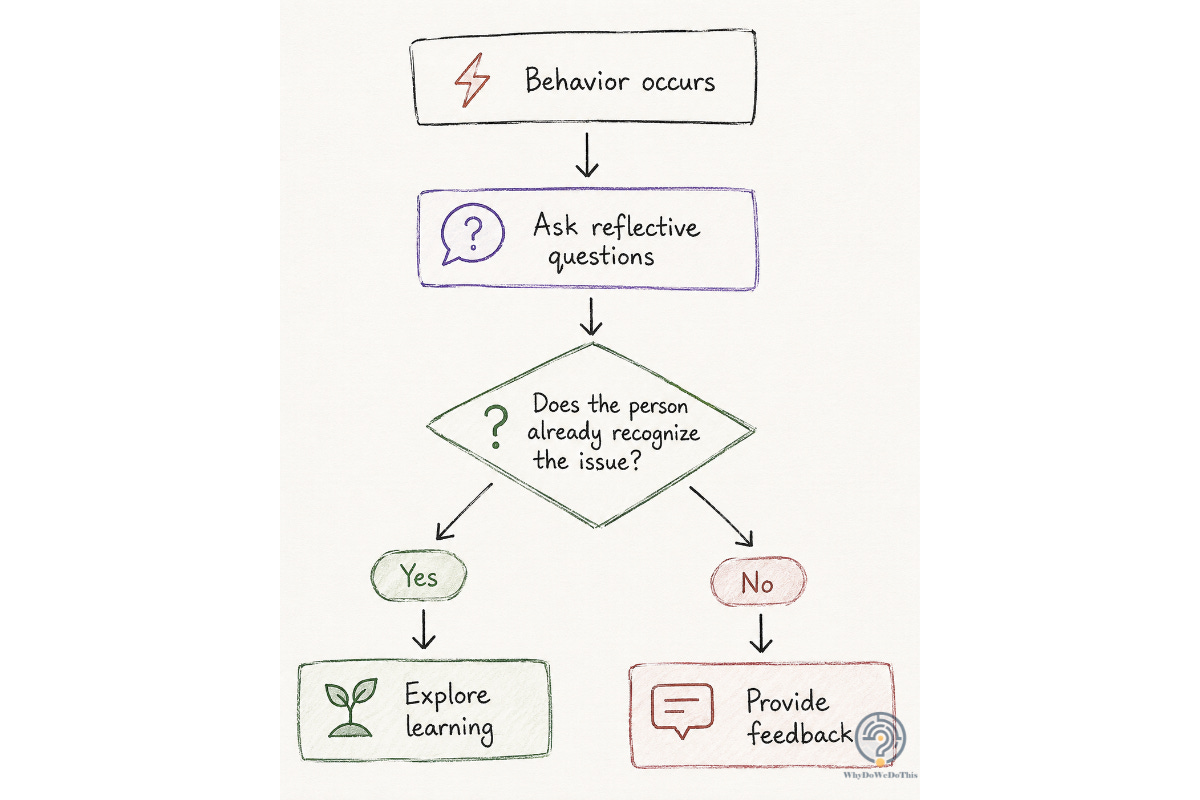
The Reflection Step (as I call it)
Another approach I have found useful is to ask a question before (or sometimes instead of) feedback. If a behavior or action in question occurred in a social situation or someone made a wrong call in general - I find it useful to open with a question about this situation or decision without judgement: “Why do you think X happened? What do you think about situation X? Why was X your decision at the time?”
Oftentimes people have already reflected on what went wrong and can already articulate the lesson they’ve learned. Sometimes you need to guide them towards the conclusion, sometimes the conclusion is already there. This small solution can make the conversation easier for all participants if both are open to discuss their actions.
Outdated Approach: The Sandwich
The framework here is to start with a compliment, then insert negative feedback, and then finish with another compliment.
Why it doesn’t work:
People anticipate the “meat” (criticism) → the compliments lose meaning.
The real message may get lost (“Was it serious, or just a small thing? Do other things I do well balance it out? Do I need to act on it?”) → lack of clarity.
Feels manipulative → erodes trust.
I recently heard an argument in its favor that this approach helps you give feedback without blowing up the relationship. I think it’s a good point if the person you need to give feedback to is very new and you don’t have a relationship yet, and in this case - it’s literally the first feedback you need to give.
In other cases, however, you already have a relationship. And if you tend to the balance of the feedback system - normally you would have already had exchanges containing positive feedback. Additionally, people on your team quickly learn who you are: they see what you say and what you do, what examples you set, and if you are a caring and congruent leader - people on your team would value this relationship, being fully aware that in a professional environment the existence of both types of feedback is normal and expected.
Being challenged during feedback
People may resist, deny, or get emotional. It’s normal.
What to do:
Stay calm: Don’t match their emotional intensity.
Acknowledge feelings: “I hear this is frustrating for you.”
Re-center on facts/impact: bring it back to SBI/NVC.
Collaborate: “What can we do differently going forward?”
Positive feedback
I like to think of positive feedback as watering a garden. If you want it to grow and bloom, you need to nurture it regularly. Positive feedback works much the same way - it is a part of communication people genuinely love and feel motivated by.
Key rules here:
Make positive feedback specific: “You did great” is nice, but “Your clear structure in the presentation really helped the team follow the argument” is far more effective.
Reinforce desired behaviors: people repeat what gets recognized.
Zero feedback is not an option.
Balance the flow: don’t pair positive and negative feedback.
Close the loop: When someone corrects their behavior, acknowledge it - it prevents lingering self-doubt or stress. People don’t need/have to wonder “Am I still in trouble?”
P.S. I’ve heard it somewhere and liked it immediately: “if someone is having a difficult conversation with you - it means that they value you enough to fight for you”. And I think it might be useful to hear for those leaders who feel very uncomfortable giving negative feedback and having difficult conversations. Yes, by all means, negative feedback is unpleasant on both ends, but a difficult conversation creates a learning opportunity for both - to be able to sit there with tension and do your best for the situation, for another person, or for an organization. It ultimately creates stronger leaders and healthier teams. It’s a skill, like any other.