


Organizations don’t pay for trust directly - they pay for the absence of trust every day through friction, delay, turnover, and lost performance.
But I’m not going to talk about turnover here - everyone knows turnover is expensive.
I’m also not going to talk about engagement - everyone knows that engaged teams perform better and produce better financial outcomes.
I’m going to talk about operational overhead, organizational drag - the painful day-to-day that leads to a decline in engagement and increased turnover.
Stephen M. R. Covey introduced a simple equation:
Low trust = low speed + high cost
High trust = high speed + low cost
It means that when there’s a lack of trust - everything becomes expensive:
communication becomes expensive,
coordination becomes expensive,
hiring becomes expensive,
management becomes expensive,
change becomes expensive,
execution becomes expensive.
What does it look like?
Downward distrust (leadership → employees) shows up as slower decision-making and increased monitoring overhead:
More approvals
More coordination
More bureaucracy
Additional reporting systems
Control mechanisms (Nordic journal of working life studies, 2017)
Additional managerial layers
Upward distrust (employees → leadership) shows up as reduced willingness to share information and a lower capacity for organizational learning:
Problems hidden
Mistakes repeated
Less innovation
Worse decision making
Reduced engagement
More absenteeism
Reduction of employer attractiveness for new hires
And across the organization, this results in increased political behaviour, promotion bias, duplicated work, and growing resentment between teams. Decision quality deteriorates, financial risks increase, potential returns decrease, engagement drops, inefficiency grows, and trust erodes even further (well backed by CIPD report and Watson Wyatt HCI Report).
Low Trust
↓
Information Withholding
↓
Poor Decisions
↓
More Controls
↓
Lower Autonomy
↓
Lower Ownership
↓
Worse Outcomes
↓
Even Less Trust
The bottom line: People create additional processes to compensate for mistrust.
Those processes require supporting processes at lower levels of the organization, additional reports, and additional meetings.
Those meetings often create the need for even more meetings... and...
Each movement triggers a ripple effect throughout the organization, adding operational costs at every level and creating friction.
After all, absence of trust sits at the foundation of the “Five Dysfunctions of a Team” model.
Research appendix for those curious about the external evidence supporting these observations →
1) The Watson Wyatt Human Capital Index (HCI) ® and Company Performance: a Definite Impact on Shareholder Wealth
(Paper presented at the 2002 International Management Conference, Society for Advancement of Management, McLean, Virginia, April 5 – 8, 2002)
“... Items measuring human resource practices in five areas--recruiting excellence; clear rewards and accountability; a collegial, flexible workplace; communications integrity; and prudent use of resources--were combined into a set of factor scores to be used to estimate the effect of HR practices and policies on overall firm performance… Watson Wyatt found that High HCI firms (those with HCI scores above the mean) continued to outperform Low HCI firms over the two years following the administration of the HCI questionnaire.”
Figure 1: 1999 HCI Scores and Subsequent Firm Performance

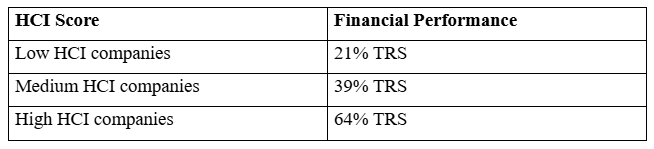
“... The result is a complete respondent base of more than 750 companies in the United States, Canada, and Europe with at least three years of shareholder returns, 1,000 or more employees, and a minimum of $100 million in revenues or market value. The results of this research are remarkably congruent with those obtained in the previous two. That is, the better an organization performs in managing its human capital (as measured by the HCI), the better its returns for shareholders. Figure 2 shows that those companies that scored in the low HCI group averaged a 21% five-year return. The medium group averaged 39%. Those with high HCI scores returned 64% over five years.”
Figure 2: Five -Year Total Returns to Shareholders (April 1996-April 2001)
“...Also, similar to the previous findings, the five HR practice areas continued to positively impact a company’s market value. Figure 3 specifies the exact relationship demonstrated by the collected data (Watson Wyatt Worldwide, 2001)...”
Figure 3: Key Links Between Human Capital and Shareholder Value Creation
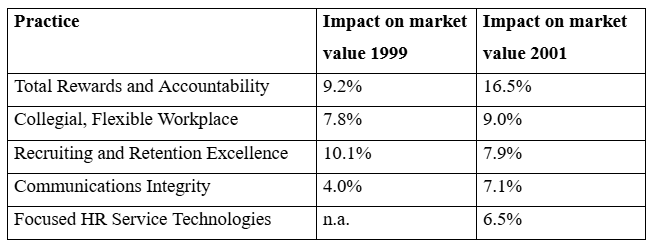
“... The analysis was interpreted to demonstrate that HR practices are not only associated with business outcomes, but also create them, rather than merely being created by them. A conclusion was that human capital practices were seen as a leading - rather than a lagging - indicator of business success.”
“In summary, then, Watson Wyatt has suggested, “It pays to manage people right” (Watson Wyatt Worldwide, 2001, p. 11)... The reviewed literature taken together with the Watson Wyatt research results presented here have clearly demonstrated the sizable, financial advantage contributed by the effective management of human resource management systems, thereby questioning an often “knee-jerk” response by business to challenging economic times. That is, it seems that a strategic decision that could be contemplated if not adopted is that organizations be more deliberate about considering alternatives that balance the impact on human and technical resources rather than leaping to the conventional approach to dealing with downturns, which may reduce costs in the short-run but lead to increased costs or lost opportunities in the long-run.”
2) CIPD Report: Where Has All the Trust Gone, 2012
(link to the original source)
“...The headline reasons for building trust include that it:
promotes successful socialisation, co-operation and teamwork
promotes and facilitates partnerships, joint ventures and cross-team working
reduces risk and decreases operating and transaction costs
reduces distractions or amount of time spent on self-preservation
builds the foundations of a social order and the basis for civil society.”
“From an HR perspective (see Searle and Skinner 2011), the case for building trust includes the following benefits:
improved employee performance
higher levels of motivation and positive attitudes (including employees putting more effort in performing and developing their roles)
reduced cost due to higher productivity, less wastage, lower staff turnover, fewer stoppages, and so on
enhanced pro-social behaviour at work including desirable work-related behaviour and appropriate discretionary behaviour
enhanced knowledge-sharing and increased innovation
improved co-operative working.”
“The evidence from existing research suggests that organisations need to invest in trust-building or trustrepairing activities to minimise the negative results of a breakdown of trust. Such negative consequences include:
growth in feelings of vulnerability among staff – this may be a cost to the organisation because of energy devoted to activities which they think will protect their jobs
unwillingness to invest in relationship-building, leading to an introverted, silo mentality within an organisation with the resultant benefit of cross-functional knowledge-sharing or co-operation lost
reluctance to engage in innovation due to feelings of inadequate psychological safety
lack of horizontal and upward communication, so important information is lost, especially for senior team
reduction in discretionary effort or engagement by individuals and teams
reduced willingness to take risks
defensiveness and/or disruptive behaviour
shift to a command and control management mentality, which can constrain performance and innovation in certain sectors
increased monitoring and bureaucracy, checking indicators of performance, takes resources in terms of management time
increased anxiety/high stress levels among staff in low-trust climates may reduce performance
low morale and loss of commitment and engagement at all levels
higher staff turnover as employees seek out more trusted employers.”
3) Significance of Monitoring and Control for Employees’ Felt Trust, Motivation, and Mastery by Vilde Hoff Bernstrøm and Helge Svare
(Nordic journal of working life studies Volume 7 | Number 4 | December 2017 - source)
“Monitoring is a pervasive part of modern information systems and work environments, allowing management to monitor employee activities and productivity without the need of direct supervisory observation. The importance of monitoring is also of particular interest in the Nordic countries due to how it might conflict with traditional Nordic work culture. While work culture in the Nordic countries is known for its high levels of employee autonomy and discretion (Eurofound, 2013), monitoring forms such as electronic registration of time use can be seen as an attempt by employers to control how employees prioritize their time and thus reduce their autonomy. Nonetheless, monitoring is increasingly being introduced also here, for instance along with new information technologies (Fornyingsog administrasjonsdepartementet, 2009). A number of studies exist, demonstrating a negative impact on the psychosocial work environment from certain forms of monitoring and employer control under certain conditions (Alge & Hansen, 2014). Negative factors associated with such monitoring and employer control include stress and emotional exhaustion (Baer et al., 2014; Westin, 1992) and counterproductive work behaviors and job performance (Douthitt & Aiello, 2001; Martin et al., 2016). It may also lead to reduced trust in management (Bråten, 2010; Holland et al., 2015) and reduced team-trust (Piccoli & Ives, 2003)...”
Sample and procedure: “The web-based questionnaire was sent to a stratified random sample of the Norwegian working population between the ages of 18 and 66 years.The sample was stratified by age, gender, sex, education, geography, industry, and company size… A total of 3015 respondents completed the questionnaire, yielding a response rate of 47.8%.”
“As we have previously argued, management’s trust in employees, and employees’ feeling of being trusted by their management should be distinguished. It is therefore important to know which factors in the workplace that actually influence employees’ felt trust. Our results support the idea that management can actively influence employees’ feeling of being trusted by assigning control over decisions and by refraining from implementing monitoring schemes, and moreover, that by implementing monitoring schemes employers may, inadvertently, make employees feel they are not trusted.”
“... Our results show that employees are more motivated, and feel a higher sense of mastery, in a work situation where they feel trusted and where they are granted the freedom to exercise control over their own work...”